Showing posts with label jean-luc godard. Show all posts

Sunday, October 27, 2013

certain tendencies

         In criticism, the takedown has a particular mystique. Unloading one's rhetorical firepower against a hated object has its satisfactions, and makes for really juicy copy. An especially nasty pan in a mainstream or at least relatively popular venue is likely to get far more eyeballs than a passionate, sincere paean to the Romanian New Wave. Moreover, if the scorn is organized into polemical argument, it can actually have lasting impact on the discourse surrounding the artist being pilloried, or even the way the art form itself is discussed.
         Take, for example, Jacques Rivette's Cahiers du Cinema review of Gillo Pontecorvo's Kapo (1960). Rivette's moralistic condemnation of Pontecorvo's decision to move the camera during a violent moment had the effect of initiating a entire strain of criticism that's lasted for decades; a problematic strain at that, but one which nonetheless compels us to ask some worthwhile questions about how movies represent atrocity. Or take Vincent Canby's takedown of Jean-Luc Godard's Nouvelle Vague (1990). His dismayed proclamation that "the party's over," in The New York Flippin' Times no less, seems to have made it officially okay for a whole swath of film writers to stop taking Godard's recent work seriously (even pans of his King Lear (1987) tended to include something to the effect of "this is the kind of bad movie only a genius could make").
         Godard's always been a divisive figure, but in the last 20 years or so, most of those who aren't crazy about him have resorted to the same reductive narrative to justify their distaste: that he was brilliant for about 7 years in the 1960s, got tangled up in Mao, and has produced empty, lifeless, irrelevant, cranky, incomprehensible, and possibly/probably anti-Semitic work ever since. And with every new Godard movie this narrative is regurgitated again, larded with only the most obvious details of the current movie. Which details, on first viewing, are admittedly the only things most people could use to describe a later Godard, unless they're already on his wavelength and fairly familiar with whatever corners of his vast frame of reference he's chosen to draw from.
         But instead of just admitting that what he's doing has escaped their grasp,* a sizable bloc of the critical establishment pronounces that there's no there there, and impugns Godard's character and the motives of anyone who happens to have found the movie in question to be a worthwhile experience that might be worth a closer look-see. It's aggravating, not only because it's a cop-out, and insulting besides, but because it's a move beneath the intelligence of some of the writers who've made it. Canby's review of course isn't solely responsible for this,** but it appears to have inaugurated this particular trend.

***

         Andrew O'Hehir's vitriolic pan of Ridley Scott's new movie, the Cormac McCarthy-scripted The Counselor (2013), isn't aiming for any grand polemical point, only juicy copy, and that's just as well. O'Hehir is a clever, engaging writer who's pitched many an out-of-the-way, oddball movie to Salon.com's readership in his day, so I have respect for him. I won't say much about the review on the whole, except that he makes The Counselor sound more interesting than anything Scott's made in 30 years, though a lot of it reads like O'Hehir is auditioning for a column at Cracked. But one line really irks me: "But despite its location photography and lustrous design aesthetic, 'The Counselor' has a puritanical devotion to boring and frustrating the audience that rivals the mid-‘90s video work of Jean-Luc Godard." 
         Which prompts a number of questions: Which of Godard's mid-'90s video works has O'Hehir seen? (Histoire(S) Du Cinema (1988-98)? 2X50 Years of French Cinema (1995)? Je Vous Salue Sarajevo (1993)?) Why do these sometimes quite emotionally direct movies suggest to him a puritanical devotion to boring and frustrating the audience? Does he think that's really Godard's intention? Why the '90s and not the '70s, which is when Godard began experimenting with video, and to largely more difficult and esoteric ends than in the '90s? Why single out the video works? Why not the features? Why not Godard's work with the Dziga Vertov group, which I'd consider the first half of that sentence an accurate description of? And most importantly, why bring up something as culturally marginalized as Godard's mid-'90s video work--some of which is almost impossible to see in the US outside of bootlegs and the Film Society of Lincoln Center's current Godard retrospective--in your snarky review of a multimillion dollar Hollywood production if you're just going to describe it in such unappealing terms? Does the average reader of Salon need more reasons to never check out Histoire(S) Du Cinema? Because that's essentially all that line will do for most who read it. And that's unfortunate, because maybe one or two or ten of those readers would find Histoire(S) Du Cinema as hypnotic, beautiful, funny, and moving as I and a number of others do. That far more egregious and dismissive things have been written about Godard by prominent film critics in recent years doesn't mean that this passage isn't complicit in the sidelining of his late work.


***

         Takedowns, even takedowns with lines like "This is more like having Alice Waters and Mario Batali labor in the kitchen for a while and then serve you a gray-green burger on Wonder Bread, with what looks like somebody’s pubic hair stuck to it," have their place in the wide weird world of criticism, but higher up the totem pole of critical responsibilities is building a bridge between difficult but rewarding work like Godard's and its potential audience. Even some Godard partisans (Godardisans?) just rhapsodize about how epochally amazing he is and never stop to consider that his methods and worldview have to be acclimated to.
         My first exposure to Godard was certainly unique in my experience of cinema up to that point, but it was hardly revelatory. Breathless (1960) was entertaining for a while, but sagged big time in the back half. Band of Outsiders (1964) was just okay. (I was 18. Such was my vocabulary.) Alphaville (1965) mainly made an impression for having one of the most perversely irritating soundscapes I'd ever heard. Contempt (1963) was gorgeous, though some of Godard's formal decisions made me feel as though I was watching a melodrama conceived by Martians. But then came Pierrot Le Fou (1965), so vibrant and playful and entirely alive moment-to-moment that it made me genuinely enthusiastic about seeing more. I saw Week End (1967), the first movie I'd ever found at once absolutely, self-evidently brilliant and a near-total ordeal to sit through. I don't think I saw another Godard after it for a couple years, but I did end up getting several of the ones I'd seen already on DVD, and they opened up considerably on a rewatch.***
         The pivot point in my transition from Godard agnostic to Godard acolyte lay in an extra on Criterion's Pierrot Le Fou DVD, wherein Godard's onetime collaborator Jean-Pierre Gorin discusses the first 20 minutes of the movie, and unpacks the many levels on which it operates, most of which had never occurred to me. The real clincher was this, on the opening sequence, where Godard has Belmondo quote a text about the painter Velasquez over a series of images of a tennis match, Belmondo browsing for books, and a twilit view of the Seine: "Are we listening to the quote? Hell no!" I realized that part of what had put me off in Godard is the sheer density of verbiage he throws around, from thick theory to advertising copy to cryptic aphorisms. We carry into movies the assumption that we are meant to fully and immediately comprehend every line of dialogue, and so upon encountering a Godard movie where obscure references, polysyllabic words, and sentences that take 4 or 5 subtitles to encompass are tossed about so cavalierly, it can feel pretty intimidating. Manny Farber indelibly summed this feeling up: "No other filmmaker has so consistently made me feel like a stupid ass."
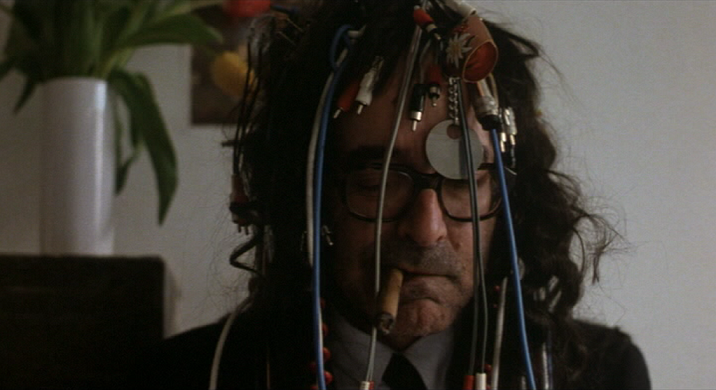
         Farber's piece on Godard is one of the best things ever written on him, but that line gives the wrong idea about how one should approach and process his body of work. The greatest pleasure of Godard, I've found, lies in the flux of images and sounds and ideas, the collagist juxtaposition of a variety of materials, and that's even more true of the later work, where the flux is more intricate and the materials more diverse. Of course, the meaning of it all matters and sussing it out is a pleasure in itself, but one shouldn't get hung up on the meanings that slip by. Once a degree of perplexity is accepted as part of the package, Godard becomes much more accessible, lively, and funny. Even though Histoire(S) Du Cinema spends a significant amount of its four and a half hours meditating on the cinema's failure to properly respond to the Holocaust, the central image in it--Godard alone in his house, puffing a cigar, pronouncing the titles of movies and books with stentorian seriousness as he uses a typewriter and futzes with an editing bay--is as comic a self-portrait as any of Hitchcock's droll cameos.
         Now, not everyone will have my Road to Damascus moment. How you feel about Godard does depend to some degree on your political leanings, your feelings about modernism, your patience with certain veins of French theory, and your convictions about what cinema should do for the spectator. There are elements of his thought that I don't care for (his belief that cinema is now a moribund art form, for starters, and the way he makes it too easy for his pro-Palestinian position to be construed as outright anti-Semitism), and I don't like some of the movies that lean heavily on those tendencies, particularly For Ever Mozart (1996). But the least he deserves, like anybody else, is to have his work evaluated on the terms it sets for itself. For once, I'd like to see a dissenting take on Godard that does just that.

*I had a miserable time with my first later Godard movie, In Praise of Love (2001). It bewildered and bored me. The few moments whose meaning I did grasp had an angry edge that I found off-putting. But it didn't once give me a sense that I was staring at the work of a charlatan who had nothing to say and was taking refuge in obscurantism to cover it up. Every image and line and music cue was clearly communicating something, it just wasn't communicating much to the cine-literate but not particularly well-read 21-year-old watching it. It's not that I didn't have the arrogance that tends to fuel Emperor's New Clothes-invoking attacks on avant-garde art (If I don't get it, nobody really does); I had loads of arrogance in me, still do. But on some maybe not entirely conscious level I got the sense that I simply didn't know as much about the world as a French-Swiss intellectual six decades my senior who has reinvented the art of cinema about a dozen times. After watching more of his work, reading some criticism and Googling a couple names Godard tends to drop, I came back to it and liked it very much, though the moments that bugged me the first time bug me still.
**Also in play is the fact that Godard is a experimental filmmaker whose historical significance and enigmatic allure is such that his work ends up being reviewed by people whose sensibilities are calibrated toward more conventional fare. Among other factors.
***The first viewing of a Godard is often just prelude to the first rewatch, the increase in comprehension+enjoyment is that exponential.

Monday, June 24, 2013

Undergraduania #2: Re: Vivre Sa Vie


This is another essay--again slightly altered--which I wrote for my film history course, this time taking a playful approach to a filmmaker who demands one. This is much closer in style to what I expect to be regularly posting here than the previous essay.


 9 Godardian Notes on Godard’s Vivre Sa Vie

          1.     description(s) of a film


1. The elliptical story of an aspirant actress driven by what appears to be economic necessity into a life of prostitution that terminates with her senseless death.
2. An ambivalent, clinical study of prostitution in France circa 1962 by a Swiss-French filmmaker with a background in anthropology.
3. A meditation on purity and martyrdom that has kinship with the work of Carl Theodor Dreyer and Robert Bresson, but unlike them continually evinces a playful self-awareness of its place in relation to film history.
4. An articulation in semi-narrative form of certain key tenets of existential thought, particularly notions of presence, individual responsibility and choice, as well as other contemporary philosophical ideas concerning the uses and efficacy of language.
 5. Jean-Luc Godard’s tribute to the beauty and vitality of his bride-of-one-year Anna Karina, but a tribute laced with an austere, doomy melancholy, so that the line between paean and preemptive eulogy is blurry at all but a handful of moments.

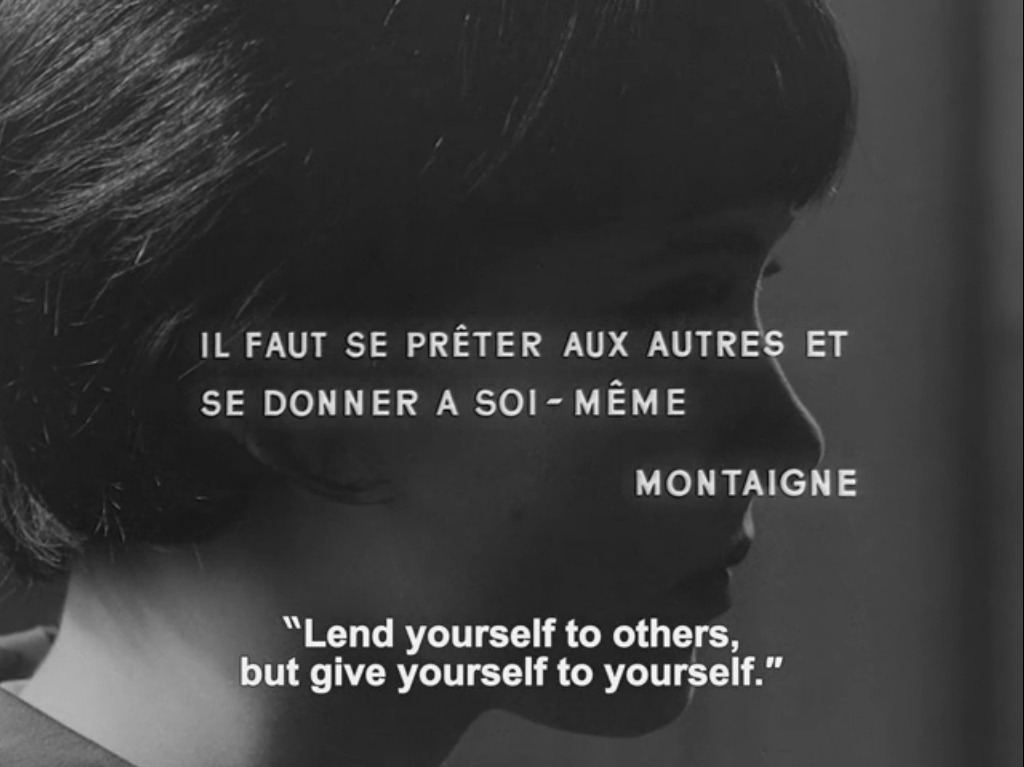
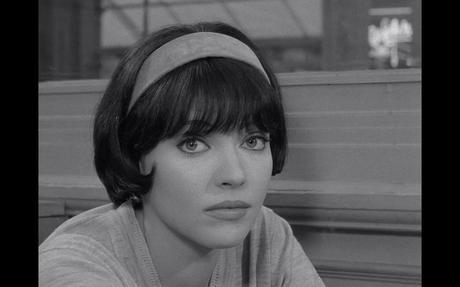
[Originally, I was going to describe Vivre Sa Vie (1962) three times in correspondence with the three views of Nana-Anna’s head in the opening title sequence, but the film is not just three things, and furthermore our 360° tour of her head is not completed until the next sequence, when we see her seated in the café from behind, followed by her beau from a similar angle.]


         2.     quotes


To me style is just the outside of content, and content the inside of style, like the outside and the inside of the human body. Both go together. They can't be separated.”—Jean-Luc Godard

Vivre Sa Vie invites a rather theoretical treatment, because it is—aesthetically, intellectually—extremely complex.”—Susan Sontag

To live means to finesse the processes to which one is subjugated.”--Bertolt Brecht

“I move my head, I’m responsible.”—Nana-Anna

All of a sudden, in the good-natured child the woman stood revealed, a disturbing woman with all the impulsive madness of her sex, opening the gates of the unknown world of desire. Nana was still smiling, but with the deadly smile of a man-eater.”—Emile Zola

“I don’t think you should feel about a film. You should feel about a woman, not a movie. You can’t kiss a movie.”—Jean-Luc Godard

“My eyes!”— László Szabó, Tableaux 6

         3.     precise facts


-The film is Jean-Luc Godard’s fourth feature.
-The film is 83 minutes, 46 seconds long.
-I have seen the film 5 or 6 times.
-The film bills itself as “A Film In Twelve Tableaux,” and each tableaux is announced by a title card.
-Susan Sontag’s famous essay, “Godard’s Vivre Sa Vie” is arranged in numbered sections, but has 5 more than Vivre Sa Vie proper.
-Vivre Sa Vie is the French title of a 1935 Joan Crawford vehicle, whose English title is not My Life To Live but I Live My Life.
-Jean-Luc Godard was 31 when the film was made; Anna Karina was 21.
-The film was released in France two days before Anna Karina turned 22.
-Nana Kleinfrankenheim is 145 days older than Anna Karina.
-“Nana” both rhymes with and is an anagram of “Anna.”
-“Nana” is the title and central character of a novel by Emile Zola, concerning the rise and fall of a prostitute.
-The man who plays “Ma Môme” by the singer-songwriter Jean Ferrat on the jukebox in Tableaux 6 and looks immensely pleased with himself is Jean Ferrat.
-La Philosophe in Tableaux 11 is the philosopher Brice Parain, whose English Wikipedia page is one very short sentence long.


          4.     boy in courtyard


    The one in Tableaux 3 in the "concierge" scene, dancing for what I've always presumed to be his catatonically bored sister, while Nana-Anna tries and fails to enter her apartment, whose rent we assume she has failed to pay. This bit is highly typical of the Nouvelle Vague's approach to mise-en-scene, in the way it playfully incorporates ambient life into a scene, even foregrounds it. For a moment we’re smiling or laughing at little Elvis Doinel’s gyrations and not paying heed to Nana-Anna’s desperation. After Nana-Anna invades the office to steal her key, the boy stops dancing. If this were a later Godard film, like Week End (1967) or First Name: Carmen (1983), he would keep going as the action unfolds, oblivious.


        (Come to think of it, my assumption that this is the boy's sister may be off-base. First of all, she doesn't enter the office with him and his parents. Second of all, her haircut and build are androgynous enough that she may well be a boy. That the child continues standing there motionless is an oddball, proto-Lynchian touch. It's almost as though they're standing outside the diegesis.)

          5.     pinball and pool


There are two scenes in the film in which characters play pinball. The first takes place in a bistro, the second in a café “in the suburbs.”  Both scenes involve men with whom Nana-Anna is in some way entangled: in the first (Tableaux 1), she and Paul—her boyfriend/husband, with whom she shares a child--take turns at the controls; in the second (Tableaux 6), Raoul—her future pimp—does the same with one of his girls.
When in Tableaux 9 Nana-Anna first encounters the lighthaired young man she is to fall for in the film’s back half, he’s playing pool.  Perhaps that’s part of the attraction. Pool is a less constrictive game than pinball. One’s agency in the game isn’t limited to two flippers and the spring-loaded launcher; the cueball can be struck from a whole range of angles, and moves other balls with its force rather than ricocheting off everything it touches. It can even fly off the table entirely. For a young woman aspiring toward existential freedom, finding a handsome young man who plays pool instead of pinball is likely to quicken the heart.


          6.     systems followed unsystematically


One reason Godard’s films are difficult to account for in standard ways is his tendency to set up narrative, structural, aesthetic, and thematic frameworks and then undermine, disobey, or replace them when the impulse strikes him. Many of his films only belatedly have discernible narratives; others abandon them entirely. Masculin Feminin (1966) claims to consist of “15 precise facts,” but what those facts are couldn’t be more vague, and only occasionally is the move from one fact to the next heralded by a numerical title card.  How many things do we end up learning about Juliette-Marina in 2 or 3 Things I Know About Her (1967)? At once far more, and far less. Histoire(S) du Cinema (1988-98) is in no way a methodical presentation of cinema history from beginning to end, or (as Godard initially suggests it to be) a recounting of a series of possible histories, but a mercurial piece of video art that proceeds by intuitive and poetic association rather than narrative logic. And Vivre Sa Vie claims to be a film in twelve tableaux, each taking a particular stylistic and thematic angle on Nana-Anna’s life. But the inclusion of multiple scenes under the same tableaux stretches the definition of the term, the narration of the quasi-documentary Tableaux 8 begins before the tableaux is announced and ends after the next tableaux begins, and the film’s seemingly austere, Bressonian aesthetic regimen is continually undermined by highly self-conscious camera moves.
Manny Farber: “[T]here is a huge gap between the purported intention of the films and their actuality. And it’s the undeveloped space between intent and end product that gives them their nutty, Dr. Kronkite character.”


Godard seems excited by systems, but he is far too iconoclastic to completely hold to one for a whole film. It is enough to have made the gesture towards a possible way of organizing a film (which is to say, one possible way of viewing the world). This is one of the reasons he gets up some people’s noses: his preference for the anticlimactic, the incomplete, the obscured, the disruptive, the half-formed, the seemingly irrelevant, the sentence that for a second seems to say everything but may not say anything, “not a just image, just an image.” What remains is a restless intelligence unfolding on the screen. In this way, Godard is one of the ultimate manifestations of the camera-stylo. All usual modes of thinking are secondary to the etchings of his cinematic pen. He draws what the philosopher and Godard supporter Gilles Deleuze calls “the borderline, there’s always a border, a line of flight or flow, only we don’t see it, because it’s the least perceptible of things. And yet it’s along this line of flight that things come to pass, becomings evolve, revolutions take shape.” Indeed things do come to pass: we ask ourselves why we’ve been telling stories in the same way for millenia, or just what a “tableaux” can be.
The only time Godard lets a single unified system guide his work is in his Dziga-Vertov period, which is also his most problematic period, the period that…

          7.     nana wonders whether she's happy

…comes closest to what dissenters of his post ’67 work think the last four decades of his career consists of.


      Back to Tableaux 9. It took me a couple viewings to work out what impels Nana-Anna to wonder if she is happy in this sequence, as the title card that introduces the sequence suggests she does. This could be attributed to my being a stupid viewer, and that's part of it, but it's also because the scene foregrounds two crowd-pleasing bits: Luigi’s little boy blowing up the balloon routine, and Nana-Anna’s ecstatic, seductive gambol around the room. Around them is silence broken by seemingly banal banter about cigarettes. I was initially inclined to take this as a patch of Godardian half-dead space, but it’s actually a crucial moment in the film, because we can subtly see the gears turning in her mind—weighing the coldness of Raoul with the seeming warmth of this new young man, who goes out of his way to fetch her cigarettes. It’s the sense of possibility she feels with regard to him that gives her the boldness to strut and preen around the room as she does.


      But, like much of Godard, the film is anti-psychological. We have no direct access to Nana-Anna’s consciousness. The measure of her life is to be taken from her actions and words, not her thoughts. I say it’s the young man, but it could very well be some evocative quality in the brand logo on the cigarette pack he fetches her that compels her to dance. Nana-Anna maintains a threshold of unknowability.


           8.     seeing seeing


           A film of eyes, and what they see. Nana-Anna gazing at men (let’s not forget in this film apparently absent of interiority that we get multiple point of view shots); men gazing at Nana-Anna (Raoul using his to force a laugh out of her). And then those sublime, uncomfortable, funny moments when she trains her eyes on us, watching her, and we realize we’ve been doing that the whole time, and furthermore that we’re not just watching her, but that we’re watching her as she’s being filmed by her husband, that she’s looking as much if not more so at him than at us, and that we’re inhabiting a mechanized version of his eyes. The lynchpin of the eye theme is Tableaux 6. The men in the café watch her, she watches them. And she takes a sustained look at us, as Godard’s camera elegantly pushes in and out, sometimes in subtle sync to “Ma Môme,” in a kind of futile investigation of her face. And then gunshots in the street, and László Szabó (not the chess player) bursts in and exclaims to the barista...


9.   hades and sons


There are two elements in Tableaux 12 that could scarcely be more on the nose. The first is the reading of Poe’s “The Oval Portrait” by Godard, whose voice plainly does not match the face of Nana-Anna’s lover; the second the sign hanging over a warehouse as Nana-Anna is driven to her death.


            The first Sontag finds to be a lapse in an otherwise perfect film. To bring the outside world (not Poe himself, but the relationship between his story and the way Godard has constructed his wife onscreen) into an aesthetic object that for her is otherwise airtight is to mock it, blemish it, taint it with reality.
Sontag seems to be longing for a film by someone with a different aesthetic M.O. If Dreyer or Bresson had made it, certainly this kind of self-reference would have been thrown out as decadent and unserious. But Godard, though certainly an admirer of those filmmakers, would rather evoke than completely inhabit their ascetic purity of purpose. Film and his own life are too intermingled for him to leave the latter out of the former.
I have nothing in particular to say about the sign. It’s cute.