Showing posts with label one shots. Show all posts

Thursday, October 17, 2013

one shots (10/18/13)

Given that I've done this a few times, it's probably worth saying here that I do these one sentence reviews partly as a stylistic exercise, to see how much I can pack in without destroying the sentence as a grammatical unit. Sometimes the exercise comes off and flows well enough, and sometimes it's an ungainly, reader-inconveniencing mess. Hopefully the below skews more towards the former.


The only British film of the '70s to be directed by a woman, Jane Arden's The Other Side of the Underneath (1972) is likely the most accurate depiction of a schizoid mindstate in cinema history, and as such is a valuable, sui generis document, even if much of it is extremely hard to take, an assault of jolting cuts, unnerving fish-eye imagery, some of the scariest sounds in existence, and long (some argue misguided and ethically dubious) scenes where the actors from Arden's Holocaust theater group, in the throes of clearly quite heavy LSD experiences, weep and ramble incoherently (at Arden's on-camera urging) about mommy and daddy and "archetypal oppression," the claustrophobia leavened slightly in the back half by a pastoral interlude at a Welsh gypsy commune before the screeching strings and blood- and nudity-intensive performance art setpieces ramp up again, all of which adds up to both a miasmatic jumble that confounds any dichotomy you might try to plug it into (fiction or documentary, success or failure, exploitation or liberation) and a significant cinematic outgrowth of second-wave feminism and the anti-psychiatry movement, though finally too grotesque and intractable to serve as a particularly good ambassador for either.


There was an assumption on the part of many, including myself, that when Kenneth Lonergan's Margaret (2011) was released on Blu-Ray/DVD last year, the extended cut included in the package would prove wholly superior to the truncated theatrical cut, and while for the first half of its 3 hours that looks to be the case--in that several wonderful sequences cut from the theatrical version are left where they belong, and the themes at play are given more time to breathe and develop--eventually certain formal decisions Lonergan makes start to chafe a little, like his promising experimentation with irrelevant background chatter on the soundtrack, which doesn't have another knockout scene in which to realize itself after the incredible cafe scene in the first half, and so is just distractingly there, ditto the long cityscape shots, which have contrapuntal purpose but drag unnecessarily, and the alternate edit of the operahouse finale, which adds another intriguing layer by focusing more on the performers onstage, but in the process diffuses the scene's overall emotional impact; nonetheless, in any version, Margaret is one of the most extraordinary movies ever made about several of the many, many things it is about: city living; adolescence as a state in itself as well as in relationship to adulthood; the atmosphere of post-9/11 NYC; and a tough fact of human subjectivity which pro forma three-act screenwriting tends to deny or obscure, namely that everyone who's right on one hand is probably wrong on the other, and while it might sometimes appear otherwise to us, the wider world doesn't much care either way; the world's only business is spinning, and all else is opera.
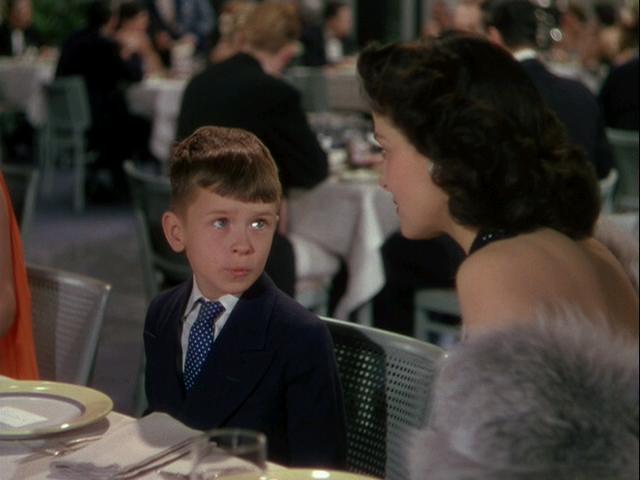

I had a degree of trepidation going into Howard Hawks's Gentlemen Prefer Blondes (1953), since from the title to the iconography from it that has infiltrated pop culture, I was expecting a heavy dose of dated gender politics in addition to the expected Hawks charms, but I should have known better, as the movie actually presents a world in which men are gullible fools (with one exception), and its two protagonists are another strong-willed, witty Hawks woman (Jane Russell, who gets one subversive musical number, "Aint' There Anyone Here For Love," in which Hawks essentially assumes the female gaze) and a woman whose dimbulb blonde routine belies genius-level situational intelligence (Marilyn Monroe, a much better actress than she's sometimes given credit for), their complicated and thoroughly plausible friendship the source of much of the movie's sneaky depth (one definitely sees where Jacques Rivette found Celine and Julie Go Boating (1974) in here--the movies thrum with the same estrogenic energy, and undercut their male characters in much the same way), though how 'bout those expected Hawks charms: he shoots in impossibly yummy three-strip Technicolor; pulls off the segues into and out of musical numbers with exquisite timing and elegance; gets away with all manner of naughty innuendo and implication; and lets even ostensibly one-joke characters give hints of an inner life (exhibit A: Henry Spofford III, pictured).

Sunday, July 21, 2013

one shots (7/22/13)


Nicolas Winding Refn's Only God Forgives (2013) has been dissed across the board, but Drive (2011), his previous, mostly well-received collaboration with Ryan Gosling, wasn't any more meaningful; it simply simulated meaning more convincingly, or at least more artfully: the plot was pro forma, but there were lively supporting turns by Albert Brooks and Bryan Cranston to distract, and though the taciturnity of Gosling's Driver may have been an empty Kitano/Leone pose, there was at least a narrative context in which it made something like sense; here, we have little to distract us from the yawning nullity at the core of Refn's ostentatious vision, which has been anointed by some cinephiles (willing to give Refn exactly the praise he wants) as Kubrickian, and which Kubrickian vision here consists of revenge as an endless cycle of pointless bloodletting (where have I heard this one before...), enacted by hollow men who, between acts of sadism (too calculated to actually shock anybody in Refn's target demo), stand motionless in dark red rooms while Cliff Martinez's spiff soundtrack groans and throbs, and stare longingly at women and swords, either because mommy doesn't wuv dem or because they're Asian and so ipso facto all in tune with the mystic or something.


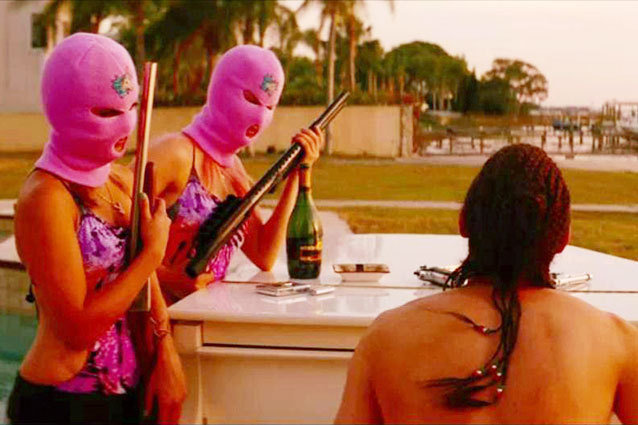
Phenomenologically speaking, Harmony Korine's Spring Breakers (2012) is the most exciting American movie of the year thus far, a druggy neon fantasia that subjects gangsta culture detritus and copious T&A to the same sort of enraptured gaze Terrence Malick trains on nature and the cosmos; intellectually, it's so blunt about its satirical intentions (e.g.: "This is the fuckin' American dream, y'all") that one wonders if they're to be taken at face value, and hazy in its execution of those intentions, which depending on how much one trusts Korine, scans as either productively ambivalent, or cowardly in a way all too common in contemporary American movies (a commitment-averse landscape in which even many of our best and brightest take care to avoid or reduce to a muddle the politics of their subjects); I generally like Korine, sometimes lots--the dada humor, scattered moments of real lyricism, a punkish disregard for taste and structure--but I'm not sure that's tantamount to trusting him.


The ideal audience for Nobuhiko Obayashi's House (1977) is a gaggle of hyperactive posthuman nymphets who live in clouds, subsist entirely on a diet of mescaline truffles, and will never know hardship or death; for us all-too-human earthwalkers its wild stylistic inventions can get a little wearying after a while, though it does serve as a useful illustration of how tenuous the boundary is between candy-coated J-pop and psychosis.


Monday, July 8, 2013

one shots (7/8/13)


What's finally enduring about Last Tango in Paris (1972) is not Brando, nor is it Schneider, Bertolucci+Storaro's autumnal images, and certainly not the sex, but the sense that all its mismatched and discordant pieces are alike straining towards a greatness that finally eludes it; not "the movie breakthrough," per Kael, but a dream of it, still hanging in the air above us like opium-smoke, ever-present but irrecoverable.


Dramatic credibility makes like an encephalograph in Sidney J. Furie's The Entity (1982), mostly depending on who's sharing the screen with Barbara Hershey (extraordinary here as a single mother beset by a sexually malicious demon), but it all adds up to a singular and gonzoid melange (decried upon its release as distasteful and exploitive, though actually about as tasteful as it can be while still being frank about its subject matter), which veers arrhythmically between blunt, almost unbearable horror, grown-up intelligence, and so-totally-'80s pulp goofiness, before ending on a note that, on paper, is as pro forma as all get out, but as it plays is deeply strange and refuses anything like typical horror movie satisfactions.


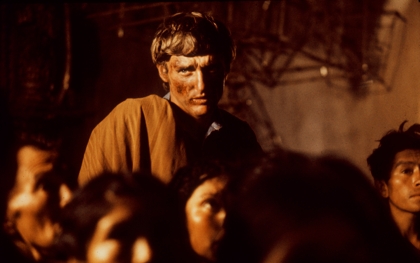
Dennis Hopper's The Last Movie (1971) takes everything wrong with his Easy Rider (1969)--the air of male privilege common to first-wave counterculture films, the outsized Generational Statement-type gestures, the instantly dated aesthetics--and ups the ante on all of it, while simultaneously subjecting itself to laborious autocritique, resulting in an experience that often feels formless and misguided in the moment, even as the spirits of Godard, Cassavetes, Rivette, and Malick (in utero) waft through, but which, in the final, 4th wall-demolishing ten minutes, snaps into haunting clarity, as Hopper surrenders completely to the void his narrative was only flimsily papering over.