Showing posts with label reviews. Show all posts

Sunday, September 21, 2014

it squelches


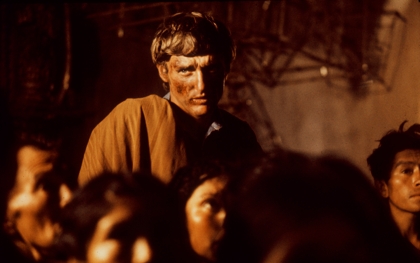
         Fitting that Hard to Be a God (2013), the movie Aleksei German spent most of this century making (he died late in the editing process, age 74), and several decades before that dreaming of, takes place on another planet, considering that his penultimate work, Khrustalyov, My Car! (1998), makes Stalinist Russia resemble a rundown colony on the barely-terraformed third moon of something-or-other. In fact, that's vastly understating the strangeness of a movie where, to pick one inexplicable moment out of several hundred, a small dog in a cage zips through an apartment on a wire in the blink of an eye, to the surprise of no one in the scene; a movie whose baseline for dialogic normality is "Boys, come over here and piss on my dog" (another dog in a movie of many dogs, canine and otherwise, this one scalded by "the whores"--or were they gypsies?); an often hysterically funny movie which also features a scene in which the protagonist is horrifically violated in the back of a prison transport; a movie in which almost nothing makes sense until the last reel, when suddenly everything does; a movie that could make you believe every one of those tired "In Soviet Russia, [noun] [verb] you" jokes actually happened to someone under Stalinism; an impossible movie and an essential one, because it lends a whole new resonance to the sentence, "History is a nightmare from which I am trying to awake."


         When Stephen Dedalus speaks those words in Joyce's Ulysses, he hasn't bathed in a while. While Don Rumata (Leonid Yarmolnik), the central figure of Hard to Be a God, is allowed the privilege of bathing, most of the people around him don't look like they've ever bathed, or even so much as thought of it. Rumata is fully enmeshed in the nightmare of history, but it isn't his native history. He's a historian from Earth living on Arkanar, another planet that developed in much the same way as ours, save that its history remains mired in an interminable Dark Age, prolonged by the slaughter of artists and intellectuals (Stalin's purges come to mind). Rumata would like to snap awake, but unlike Dedalus, he can't stand at an intellectual remove from the nightmare. He's forced to accept its terms, to be as barbaric as everyone else in this world where so much shit fills the streets there are devices bolted to the floors of houses for scraping it from one's boots.


         Hard to Be a God is a septic masterpiece, containing images so repulsive you either can't quite peg what they are or wish you couldn't, but not one of them in all its three hours feels gratuitous, and they're interspersed with many images that astonish. Sometimes they pop up in the same shot: a track through rotting corpses hanging from a scaffold gives way to a fog-shrouded vista straight out of Tarkovsky's Andrei Rublev (1966); a sequence shot begins with a close-up of the giant penis of a donkey, pans upward as the donkey trots off to reveal a man stepping out of a latrine, then alights on a girl whose beauty registers in this squalid context as a visitation. The plot and dialogue are frequently impenetrable, but German's vision is far too consistent, too thought-through, for the movie to feel incoherent. When we lose the thread, it's because the world he's painstakingly invented is so stubbornly, grotesquely alive that it can't sustain the illusion of a clean, straightforward narrative. German makes Swiss cheese of the fourth wall, with characters constantly looking into the camera as it passes by, which simultaneously recalls the political docudramas of Peter Watkins, and the uncanny way NPCs turn to look at the player in certain video games,* as well as that line from Chris Marker's film essay, Sans Soleil"Have you ever heard of anything stupider than to say to people, as they teach in film schools, not to look at the camera?" 
         Why isn't Hard to Be a God, a long, grody swim in the muck, unbearable to sit through? Why could I watch it again right this instant? Besides the fact that its sheer visual density would be the envy of Terry Gilliam and Erich von Stroheim, there's German's sense of humor. Maybe to some "Your grace, somebody saw a dude with gills in the creek," won't register as the funniest line of the decade so far, but that's their loss. Then there's the constant sense of non-sequitur from which much of that humor arises, and which functions as an implicit rebuke of any attempt to boil the movie down to a condemnation of the bestial ugliness of humanity. We might be nasty, venal creatures one missed Renaissance away from rolling around in our own excrescence, but you never know what we're going to come out with next.

*There is actually an Hard to Be a God game, based on the same 1965 novel by Boris and Arkady Strugatsky, as well as another movie adaptation from 1989 by Peter Fleischmann, neither of which bear much resemblance to what German gives us here. The game looks like a sanitized snooze (judge for yourself), though a Metacritic user avers that while "you will find a game that is first very confusing," if you "keep on playing... the storyline unfolds to reveal a plot that rivals neverwinter nights one," so it's maybe not nothing. And I must concede the Fleischmann version has a superior theme song.


Thursday, June 19, 2014

catching up #2


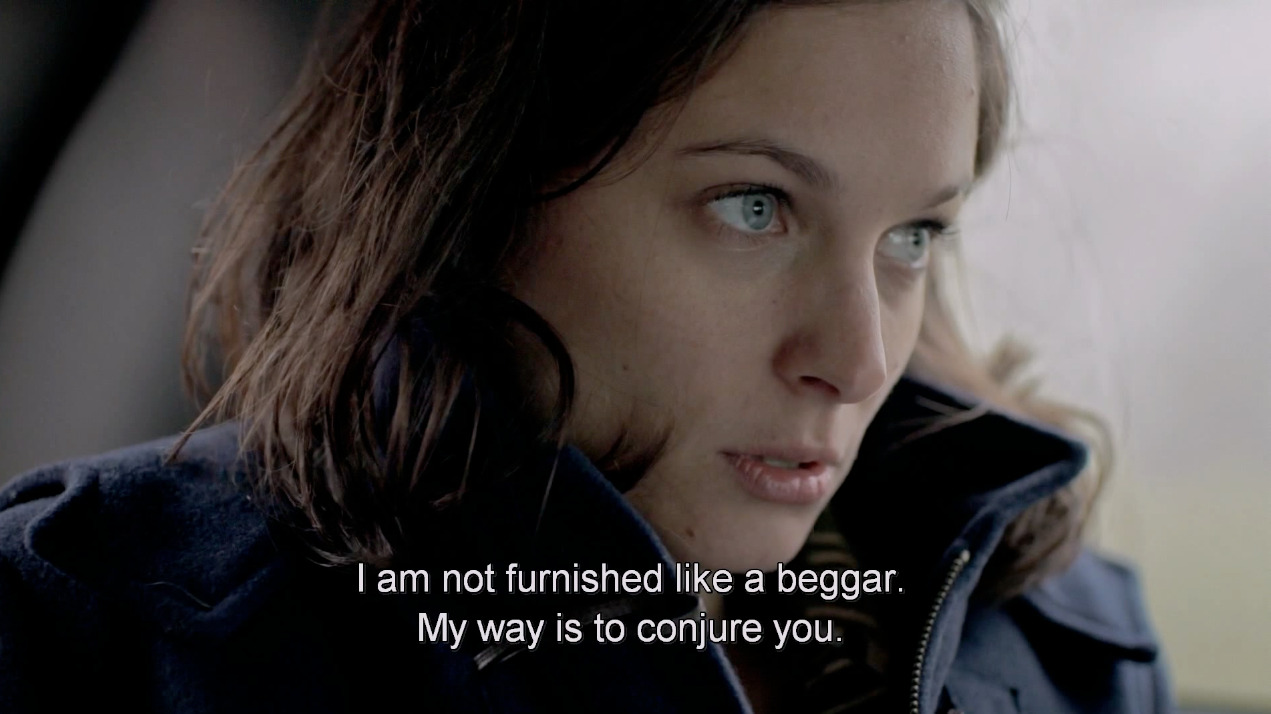
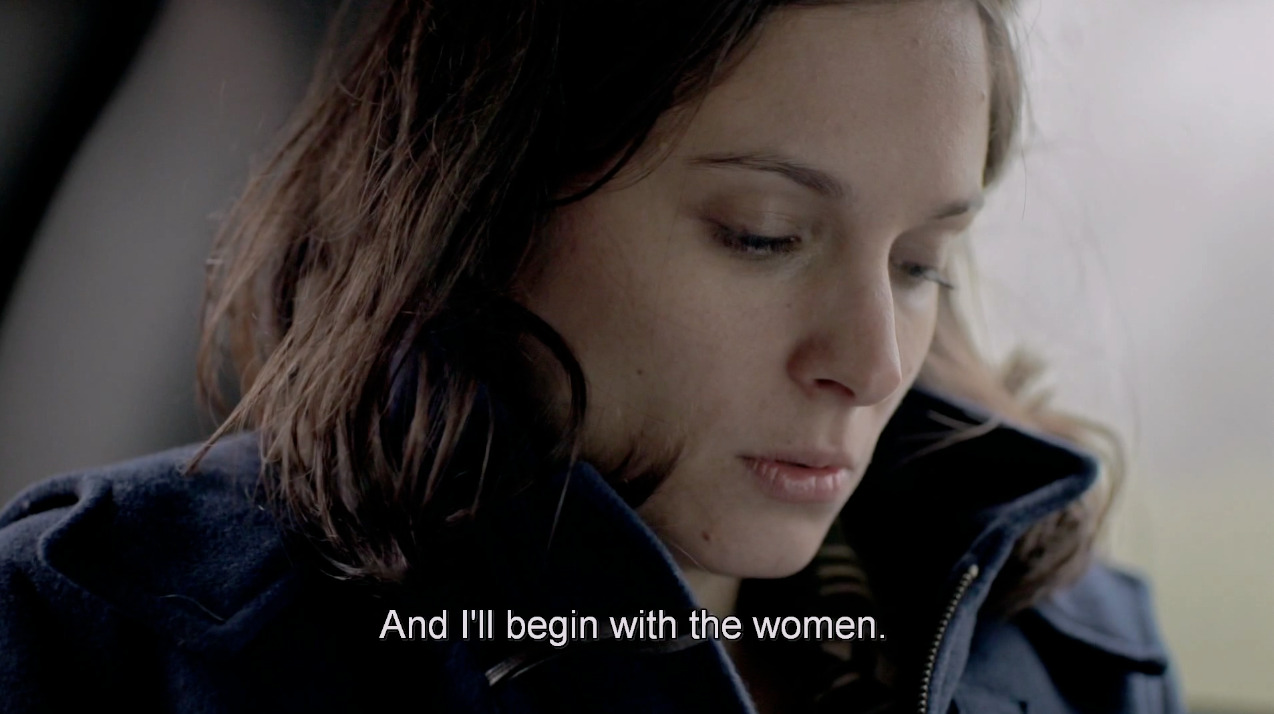
         Every time I watch Matias Piñeiro's Viola (2012), I understand more and less of it. It inspires a pleasant kind of vertigo. It's the kind of movie you immediately want to write a poem about,* or draw maps of, like Gilles Deleuze did with Jacques Rivette's Gang of Four (1988), to luxuriate in the tricky elegance of its construction. One could map individual scenes, the way the actors--mostly women, all of them fantastic--move through space, at once naturalistic and sinuously choreographed. I'm thinking especially of the long scene where Cecilia (Agustina Muñoz) seduces Sabrina (Elisa Carricajo) under the pretext of running lines for Act 1 Scene 5 of Twelfth Night. They run through the scene several times, and as they do, they move around the room, drawing close, turning away, lying down on the couch, getting up, encircling and cornering each other, Piñeiro's camera gliding in sync with them in a lengthy take. There might be a cut somewhere, but after three viewings I've yet to notice, much as it's hard to pinpoint where one thought fades into the next when daydreaming. After a certain point, the text loses its meaning, becomes pure speech, then regains its meaning and develops new dimensions. It's disorienting, hypnotic, playful, and erotic, and makes up about 10 of Viola's 62 minutes, 62 minutes that are dense with words, gestures, implications, enigmas, but never in an undue hurry, like a midafternoon stroll taken with the most interesting people you know. Comparisons can and have been made to Rivette, but Piñeiro puts his camera closer to his subjects, and the mysteries he generates are more localized, less sinister. It might be more useful to consider it in relation to contemporary American microbudget cinema, with its slender length, twentysomething neo-bohemian characters, and lack of capital-D Dramatic incident. I won't say Viola is "better" than what's been happening on the low-/no-budge circuit up here, as there's a lot I haven't seen and several I've seen that I like just as much, but I think we could all learn a great deal from it, as Piñeiro seems to have internalized Italo Calvino's Six Memos for the Next Millennium** more thoroughly than any other young filmmaker today.


*I gave it a shot:
Your way is to conjure me
And you'll begin with the women of Buenos Aires
Who weave through space and into being other worlds
With the Bard's words or their own,
Both equally likely to slip abruptly into couplets.
Traces to be found here of the Phantom Ladies and the Gang of Four,
But the schemes of Piñeiro's ladies are more earthbound,
Less loaded with ominous metaphysical implication
(they care more about Love, less about Conspiracy).
Small movies in a big world aren't small at all
Provided they know what boundaries to stand astride
(fiction/nonfiction, dream/reality)
And which interstices between adjacent worlds get the most light.
**Lightness, quickness, exactitude, visibility, multiplicity, consistency.


         Like Someone in Love (2012) is Abbas Kiarostami's horror movie, or at least suggests he could make a great one. Almost nothing outwardly horrific happens in it (actual physical violence is withheld until the very last second) and stretches made me want to crawl out of my skin. It's largely a matter of what's in the frame and what's out, of what information he chooses to foreground and what he leaves on the backburner. He keeps the one menace in the story, Akiko's (Rin Takanashi) obsessive-abusive boyfriend (Ryo Kase), in the background for much of the movie's length, and places heavy emphasis on the nattering babble of metropolitan life--inconvenient phone calls, obnoxious monologues by nosy neighbors, an endless series of painfully sad voicemails from Akiko's grandmother--which don't so much diffuse the threat as heighten it, make it an implicit presence in even the most innocuous occurrence. The effect is somewhat like Haneke, and better, since Kiarostami's meanings aren't so boldfaced and scolding. The difference between Kiarostami's other work and Like Someone in Love is much like the difference between the two versions of Jacques Rivette's Out 1: Kiarostami's other movies open Out; this one closes In. We are as entrapped in it as Akiko is in her call-girl job and awful relationship, and sense palpably the void that yawns beneath the city, beneath language, beneath love, which exists here only in semblances and simulacra, save maybe in the connection that develops between Akiko and her ostensible John, Takashi (Tadashi Okuno), though what binds them is finally too ambiguous to be easily classified as anything but itself.


Tuesday, March 25, 2014

@berkeley


         Frederick Wiseman picks a piece of the world and films the hell out of it. He picks it because it's interesting to him, not because it's "relevant." "Relevant" being whatever corporate media thinks the public should find more important than other things at a given moment. "Relevant" acknowledges why a movie about Berkeley might be important right now, but doesn't see why such a movie has to be so long or include lengthy discussions of poetry, time, and astrophysics. ("Relevant" will have no truck with reflection or metaphor. "Relevant" is a Brueghel canvas seen through a keyhole.) "Relevant" is likely why At Berkeley (2013) aired on my local PBS station two months ago in a timeslot (11pm-3am) prohibitive to everybody but diehard cinephiles and insomniacs, slightly less of an insult in the age of DVR (which I don't have), but only slightly. "Relevant" is also why Wiseman has never been nominated for an Oscar, and why Netflix won't answer his letters. All of this is not to suggest that he's an embattled or marginalized figure (he has, as is frequently noted, become something of an institution himself) but his work represents a mode of thinking about the world that's highly unfashionable in the age of Upworthy and its like.
         Sure, At Berkeley has a more obvious bearing on the zeitgeist than his last movie, Crazy Horse (2011), a study of the Parisian burlesque club of the same name, but its "relevance" feels unforced and organic, discovered rather than imposed or assumed. The problem with some social issues-type documentaries is the filmmakers seem to know already more or less what they're going to say, and making the movie is just a matter of collecting facts and scintillating footage to support what the initial thesis is. Not that there isn't a place for that kind of documentary, but it tends to make for flat, primarily informational experiences, exhausted of their riches after a single viewing. At Berkeley makes a definite argument about the state of higher education in America, but that argument isn't immediately apparent. Instead, it's emergent, largely assembled from long blocks of time in lecture halls and meeting rooms, in which conversations between subjects are allowed to ebb and flow, as conversations do. These scenes are often fascinating in themselves, both for the heady intelligence of the discussions and the immanent quality of Wiseman's images (he seems incapable of filming a person without making one aware of the complex interweaving of historical and biological forces that have molded them into what they are). But when the scenes are juxtaposed with each other, further levels of meaning (echos and linkages, running themes and subthemes) gradually accumulate, forming a complex and cohesive statement. Perhaps due to Wiseman's spurning of the usual viewer guideposts (narration, interviews, identificatory chyrons), or the slowness with which At Berkeley builds, one feels Wiseman is unearthing his argument at the same time you are.
         I don't agree with all aspects of that argument. While the student protests that take up about an hour of the movie's second half may have been as inchoate and abortive as Wiseman suggests they were, and the administrators might be the entirely decent, principled and well-meaning people he depicts, I nonetheless found myself wishing Wiseman would sacrifice his umpteenth study in faculty meeting inertia for a scene among students discussing their hopes, worries, and longings without the mediation of an authority figure. But that one reservation aside, when At Berkeley ended I felt newly awakened to the polyphonic complexity of this grand, wacky circus we call civilization. At three in the morning, no less.*


*Which is actually when most such epiphanies occur, so maybe there was some higher logic to PBS's scheduling than I was willing to concede.

Friday, November 22, 2013

cannibal bunny ferox


         Laying eyes on the unpromising poster for Gore Verbinski's The Lone Ranger (2013) in the lobby of my local cineplex about 8 months ago, I turned to my companions--whom I think I'd just seen Spring Breakers (2012) with--and said: "It's a plot. They're trying to turn it all into the same movie." Yet another moribund property that wasn't doing no harm to nobody had gotten sucked up into the Viacom-Disney-Bruckheimer-ComicCon vortex and was soon to be spat out into theaters in some vaguely recognizable and eminently forgettable form. A not unreasonable assumption, given the State of Things in Hollywood Today, but one which sitting through The Lone Ranger confounded, since it really doesn't play like anything else this year.
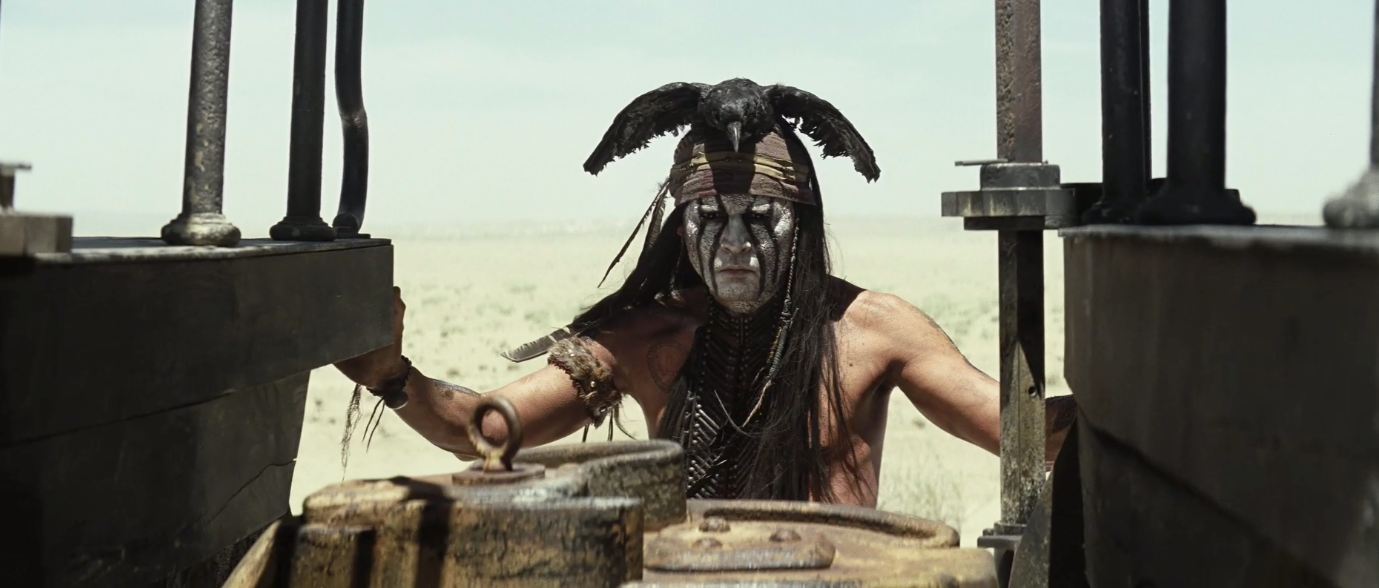
         Now, this is not to say it doesn't play like other movies, since it's basically an antic patchwork of Western tropes, with specific references made to Dead Man (1995), Once Upon a Time in the West (1968), Little Big Man (1970), and easily three dozen others, the frenzied action sequences and surprisingly high nastiness quotient evoke Temple of Doom-era Spielberg, and Gore Verbinski's own Pirates of the Caribbean movies have the same everything-the-kitchen-sink-and-a-giant-stonking-octopod approach to narrative. But unlike the Pirates movies or the Robert Rodriguez fanboy wank fiesta of the month, it uses its overflowing box of borrowed parts to make a statement about American history that's halfway coherent if you look at it from the right cockeyed angle, essentially giving us a depiction of capitalism as a psychotic organism, a vampire squid that spread its rail-tendrils across the West, suffocating all that was weird and good in the landscape and native peoples only to later resurrect them as sad, farcical carnival attractions. Which bitter truth is then refracted through the prism of tragicomic madman Tonto's (Johnny Depp) fevered brain as he narrates his and the legendary title character's early adventures from inside one such sad farcical carnival attraction, an otherwise static historical diorama, to a doe-eyed kid in a Lone Ranger costume. And the whole thing might just be that kid's fantasy or hallucination, considering Tonto's Golem-like presence makes little logical sense, and that, judging from the size of the kid's peepers, he may have consumed some peyote-laced cotton candy just before wandering into the movie.
         The message is nothing new, and despite the semi-clever metafictional element, this is hardly the most sophisticated rendering of it thus far presented to us, but encountering it in a $250 million blockbuster produced by the Walt Disney Company is nonetheless bracing. Many were quick to call hypocrisy, but now that the movie's acquired the status of a film maudit (critically lambasted and financially disastrous,* this year's (more or less pre-)designated whipping boy for the excesses of Hollywood), it's a little easier to reconcile its anti-capitalist message and its bloated, wasteful production. The dissonance isn't resolved, exactly, but it now has the kick of spending a profligately expensive and debauched night out on the boss's dime, the boss in this case being Mickey Mouse.


         It's a dicey position to be in, making movies on this scale and actually wanting to communicate something. Christopher Nolan tries, but tries so hard and with such humorless bombast that the fact that his movies are Saying Something eclipses whatever they're actually saying,** which reached its nadir with The Dark Knight Rises (2012), a half-assed salad of culturally-loaded signifiers adding up to absolute zilch. Verbinski takes us to some serious territory here, but he never gets drunk on Significance. He makes his point and moves on to the next booth at the geek show. This can be jarring, but I find The Lone Ranger's much-pooh-poohed schizophrenia of tone--which at its most extreme takes us from outrage and grief over a Commanche tribe massacred by gatling gun (which basically functions in the movie's schema as stand-in for the entire Native American genocide) to a weird sight gag about a horse in a tree in about a minute of screentime, to be far preferable to Nolan's relentless dourness. I think my preference has something to do with that famous line from another iconic duo, Deleuze and Guattari***: "A schizophrenic out for a walk is a better model than a neurotic lying on the analyst's couch." 
         Nolan is Hung Up, see: there's the dead wife complex; the flat left-brain tidiness of his images and concepts; the logorrheic self-explication (whether it's in the form of exposition or clunking subtext-as-text thesis statements); the way his movies hype themselves up trailer-style with quick spatial-relations-who-needs-'em crosscutting and a near-constant assault of booming, brooding music. Both he and Verbinski like convoluted narrative structures, but Nolan needs his structures to be perfectly symmetrical and clean and for the most part doesn't seem to care much about making the people wandering around inside them have the full, messy presence of organic life. Verbinski's structures are allowed to evolve more organically and teem with life--weird, messy, funky life, from snaggle-toothed henchmen who like to dress up in nighties and bonnets to menace their captives, to cannibal bunnies,**** to something as simple as a gross closeup of a desperado's urine streaming voluminously into a cuspidor.
         Certainly there's an element of the mechanical in his work. His crazier action sequences can play like some nightmare Rube Goldberg would wake up from in a cold sweat, gasping "What have I wrought?" But the mechanical is always overlapping with the organic, the big CG displays punctuated by gags from the Buster Keaton playbook (sometimes from some throwaway appendix of BK's playbook, but still fully in the tradition), the actors never quite becoming weightless puppets despite the touch-and-go relationship with earthbound physics, Armie Hammer always retaining his essential Armie Hammerness even as he and his steed (Silver here is reconfigured in a typical Verbinski touch as some kind of mystic destiny horse prone to erratic behavior) gallop down the length of a CG train speeding through a CG mountain range to the strains of the William Tell Overture, which climactic sequence made me feel ten again for a few fleeting minutes.
        All of this is not to suggest that I am as over the hill for it as some of its other defenders. A few of the gags and one-liners are kind of lame, and while I admire the degree to which the romantic subplot depends on glances and implication, it's still a bit anemic. But I can get behind Verbinski's gonzoid M.O., and that counts for a lot. His stuff is the closest thing we're going to get to cinematic anarchy on a nine-figure budget, at least until people who know and care about movies-as-movies are back in a position to greenlight them in mainstream Hollywood again.


* Though it still made enough money to fund 4000 Computer Chesses.
** His stuff reminds me of the way you'll sometimes find "deep themes" or "mature storylines" on the features list on the back of a videogame box, just above "17 Awesome New Power-ups."
*** Deleuze: The Lone Ranger. Guattari: Tonto. But I will listen eagerly to arguments for the inverse.
****Another sticking point for people, and yeah, one could make the argument that they're a good example of the downside of Verbinski's excess. But having the coming of the railroad and all it portends actually drive the fauna insane extends the movie's critique of capitalist greed to an elemental level. All of which is gotten into at greater length and depth in this lovely exegesis by Ryland Walker Knight, one of the reasons I watched this thing in the first place.

Monday, October 28, 2013

Put your love in me / Babe / I need you now and forever


         There are plenty of film artists who demand a more active spectator than conventional narrative cinema does. What makes Claire Denis a standout among them is the degree to which the spectator, in filling in for themselves some of the connective narrative tissue between her images, is actually assumed into the machinery of the movie. Of course, this is true to some extent for most movies--the process is called "suturing" in film theory--but the kind of suturing that takes place with a Denis movie is both more complex, and (if you're willing to roll with her languid rhythms and almost total eschewal of exposition) more intense. The viewer's input is an essential part of her movies' completeness as cinematic objects. If you're more inclined to stand back and view a movie as a tidily-constructed thing-in-itself, her stuff will probably frustrate the hell out of you. But she doesn't make "puzzle" movies. Each image in a Denis movie possesses an affective resonance that extends beyond whatever function it might serve when its narrative significance is gleaned. As she said in a recent interview, "When you have a little space, it’s not for the audience to think, it’s for it to GO with the film." If you're willing to GO with Denis's movies, they can take you to sublime places, as well as deeply unsettling ones. The degree of complicity an active spectator has in the construction of a Denis movie makes the ones where she delves into the dark side of human nature especially disturbing. Much of her work has a degree of darkness (e.g., I Can't Sleep (1994) involves a serial killer who targets the elderly, but the movie surrounding that plot thread is so colorful and vibrant that it bears no resemblance to a horror movie), but Trouble Every Day (2001) and her latest movie, Bastards (2013), can safely be categorized as her Dark Ones. Trouble Every Day (2001) takes what seems like an outlandish B-movie idea--that there exist people who are driven to commit acts of cannibalism when sexually excited--and grounds it in a realist conception of human desire, so that the dividing line between kissing someone and biting their face off becomes discomfitingly blurry. Bastards has been called a noir, and it has the shape of one: a convoluted story about the deviant horrors concealed behind the slick surfaces of upper-class normalcy; deep, dark shadows, deepest and darkest around the eyes of Michel Subor, the most iconic embodiment of pure evil I've seen in cinema in some time; a character (Chiara Mastroianni) who turns out to be something like a femme fatale; a palpable-at-every-second sense of moral rot. But what it really is, at bottom, is a cry of disgust that the structure of power capitalism has created enables the well-off to get away with all manner of depravity without repercussions. It's blunt in its intentions from the title on down, which has led to complaints that it lacks her usual grace and nuance. The contentious final scene, where Denis shows us a video recording of the sickening act (inspired by the most infamous scene in Faulkner's Sanctuary) that kicked off the plot, has been called gratuitous and an empty provocation. It doesn't tell us anything we didn't know already, and by ending things there, she leaves us both harrowed and unsatisfied. It will make most viewers feel like they've been had. But I don't think Denis simply wants to provoke. If provocation was the chief goal, she could have made it more explicit than it already is, and the shot choices less impressionistic (really, for an amateur recording, the scene sure looks an awful lot like a Claire Denis movie). And what of the attention paid in several shots to Lola Creton and Laurent Grevill's faces, which seem to register emptiness, resignation, and tenderness simultaneously? The scene is shocking, but it's not only shocking. Nonetheless, while Bastards contains nothing as hard to watch as a couple passages in Trouble Every Day (everyone who's seen it knows which I'm referring to), it is her bleakest, toughest, least forgiving piece of work. Trouble Every Day at least has a scene where Tricia Vessey cuddles a puppy.


Thursday, October 17, 2013

one shots (10/18/13)

Given that I've done this a few times, it's probably worth saying here that I do these one sentence reviews partly as a stylistic exercise, to see how much I can pack in without destroying the sentence as a grammatical unit. Sometimes the exercise comes off and flows well enough, and sometimes it's an ungainly, reader-inconveniencing mess. Hopefully the below skews more towards the former.


The only British film of the '70s to be directed by a woman, Jane Arden's The Other Side of the Underneath (1972) is likely the most accurate depiction of a schizoid mindstate in cinema history, and as such is a valuable, sui generis document, even if much of it is extremely hard to take, an assault of jolting cuts, unnerving fish-eye imagery, some of the scariest sounds in existence, and long (some argue misguided and ethically dubious) scenes where the actors from Arden's Holocaust theater group, in the throes of clearly quite heavy LSD experiences, weep and ramble incoherently (at Arden's on-camera urging) about mommy and daddy and "archetypal oppression," the claustrophobia leavened slightly in the back half by a pastoral interlude at a Welsh gypsy commune before the screeching strings and blood- and nudity-intensive performance art setpieces ramp up again, all of which adds up to both a miasmatic jumble that confounds any dichotomy you might try to plug it into (fiction or documentary, success or failure, exploitation or liberation) and a significant cinematic outgrowth of second-wave feminism and the anti-psychiatry movement, though finally too grotesque and intractable to serve as a particularly good ambassador for either.


There was an assumption on the part of many, including myself, that when Kenneth Lonergan's Margaret (2011) was released on Blu-Ray/DVD last year, the extended cut included in the package would prove wholly superior to the truncated theatrical cut, and while for the first half of its 3 hours that looks to be the case--in that several wonderful sequences cut from the theatrical version are left where they belong, and the themes at play are given more time to breathe and develop--eventually certain formal decisions Lonergan makes start to chafe a little, like his promising experimentation with irrelevant background chatter on the soundtrack, which doesn't have another knockout scene in which to realize itself after the incredible cafe scene in the first half, and so is just distractingly there, ditto the long cityscape shots, which have contrapuntal purpose but drag unnecessarily, and the alternate edit of the operahouse finale, which adds another intriguing layer by focusing more on the performers onstage, but in the process diffuses the scene's overall emotional impact; nonetheless, in any version, Margaret is one of the most extraordinary movies ever made about several of the many, many things it is about: city living; adolescence as a state in itself as well as in relationship to adulthood; the atmosphere of post-9/11 NYC; and a tough fact of human subjectivity which pro forma three-act screenwriting tends to deny or obscure, namely that everyone who's right on one hand is probably wrong on the other, and while it might sometimes appear otherwise to us, the wider world doesn't much care either way; the world's only business is spinning, and all else is opera.


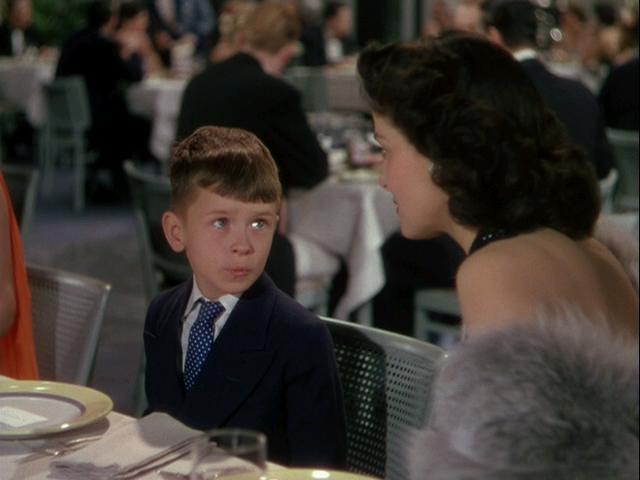
I had a degree of trepidation going into Howard Hawks's Gentlemen Prefer Blondes (1953), since from the title to the iconography from it that has infiltrated pop culture, I was expecting a heavy dose of dated gender politics in addition to the expected Hawks charms, but I should have known better, as the movie actually presents a world in which men are gullible fools (with one exception), and its two protagonists are another strong-willed, witty Hawks woman (Jane Russell, who gets one subversive musical number, "Aint' There Anyone Here For Love," in which Hawks essentially assumes the female gaze) and a woman whose dimbulb blonde routine belies genius-level situational intelligence (Marilyn Monroe, a much better actress than she's sometimes given credit for), their complicated and thoroughly plausible friendship the source of much of the movie's sneaky depth (one definitely sees where Jacques Rivette found Celine and Julie Go Boating (1974) in here--the movies thrum with the same estrogenic energy, and undercut their male characters in much the same way), though how 'bout those expected Hawks charms: he shoots in impossibly yummy three-strip Technicolor; pulls off the segues into and out of musical numbers with exquisite timing and elegance; gets away with all manner of naughty innuendo and implication; and lets even ostensibly one-joke characters give hints of an inner life (exhibit A: Henry Spofford III, pictured).

Monday, October 7, 2013

floaty people


         Alfonso Cuaron's been getting Stanley Kubrick comparisons since he chose to employ several audaciously long and logistically complex shots in Children of Men (2006), a very, very good dystopian action movie, and those comparisons have ramped up further with Gravity (2013), an even more technically sophisticated thriller that occurs almost entirely in zero-G, and so inevitably must be compared to 2001: A Space Odyssey (1968). Reactions to the movie have been mostly very positive, though its failure to match 2001 in metaphysical reach and structural originality is a common refrain. I don't think it has to be, because beyond the fact that Cuaron wants to impress with technical gambits, his sensibility could hardly be less Kubrickian. While Kubrick during his lifetime was the subject of far too much tut-tutting about chilliness and misanthropy, the man was no humanist. Cuaron is, and that changes everything:
  1. His stories are driven primarily by the agency of his characters, rather than the operations of social/technological/metaphysical systems to which his characters are subject. 
  2. His movies originate not from a grand abstract idea, but a high concept with an immediate emotional hook.
  3. The acting is naturalistic rather than baroque, stilted, or caricatured.
  4. He mainly uses music to complement or underline the emotional content of a scene rather than provide ironic counterpoint to it. 
  5. There's a realist earthiness to the way he and DP Emmanuel Lubezki film actors and environments. This quality is less manifest in Gravity due to the sheer amount of CGI involved, but it's very much present whenever we're given a closeup view of the actors, especially Sandra Bullock (seemingly half the movie happens on her face). And the last shot of the movie is nothing if not earthy.
  6. His virtuosic long takes work in sympathy with his protagonists, alternating between following their movements and assuming their point of view, whereas when Kubrick is following a character with his camera, he often does so with such mathematical precision as to create a sense of otherworldly displacement.
         If we simply compare Cuaron to Cuaron, there's some cause for legitimate disappointment in Gravity. Both it and Children of Men are survival stories, but the latter is also an emotionally convincing if not especially coherent allegory for the endurance-against-all-odds of leftist-humanist hope during the Bush administration, thick with all manner of loaded if undergraddish cultural signifiers (Abu Ghraib, a T.S. Eliot citation in the end credits, the pig balloon from the cover of Pink Floyd's Animals, John Lennon's "Bring on the Lucie (Freeda People)," Jarvis Cocker's "Cunts Are Still Running the World," much religious iconography). Gravity has no such allegorical ambitions, and politically Cuaron limits himself to a couple easy One World-type gestures (a postcard Rublev in the Russian space station is doubled by a Buddha statue in the Chinese one). The dialogue is cliche-heavy and relies a bit too much on cornball astronaut humor, the musical score is tin-eared and intrusive, and the emotional meanings are way overstated.* Bullock's character has the exact same Tragic Event in her past as Clive Owen's did in Children of Men, and it felt much less like a cheap shortcut to character depth the first time around, maybe since it dovetailed more neatly with the movie's premise.
         But I far prefer it to James Cameron's Avatar (2009), both because it's shorter, simpler, and never quite flat-out idiotic, however improbable Bullock's last-second escapes get, and because Cuaron is venturing slightly outside the expected visual grammar of mainstream cinema in search of a grammar better suited to 3D. A movie getting an audience in a megamall theater to sit in silence for over ten minutes watching a single shot unfold is a sign of some kind of progress, even if half of that shot involves things going zip and woosh and boom. The society of the spectacle has produced much worse.


*At one point, while Bullock's character, grief-stricken for some time over the loss of her young daughter, is trying to keep George Clooney's character from drifting out into space and certain death, he says to her, "You need to learn to let go." Aaaand boom goes the metaphor.


Sunday, September 29, 2013

Fading flowers in her hair / She's suffering from wear and tear / She lies in waterfalls of dreams / And never questions what it means


         Olivier Assayas returns to his formative years for the second time with Something in the Air (2012, better French title: Apres Mai). What distinguishes it from his first go-round with the era, Cold Water (1994, maybe his best movie), is first a more direct countenancing of the political situation in France in the aftermath of May '68, kept mainly implicit in the strained relationships between the generations in Water, and second a diffusion of focus. The main thread is the evolution of the Assayas surrogate Gilles (Clément Métayer, a dead ringer for Ziggy from The Wire if there ever was one) from high school radical to politically disengaged artist, but the movie roams promiscuously into the lives of various other characters in Gilles's orbit, and Gilles's own path takes a few detours. If Water is akin to a tightly constructed short story or novella, Air is more like a discursive memoir, and indeed Assayas has also written a memoir of sorts about this period in his life, A Post-May Adolescence. This has led some to complain that Air's second half is too scattered, but the scatter is what Assayas is going for. The movie is very much about how the collective dream of revolution went to pieces and left many of its young proponents chasing individualized dreams of self-actualization. A more legit complaint you could lodge is that Gilles as Metayer plays him is a little too recessive and inward for the movie's own good. Assayas's best films tend to pivot on a great performance, from Maggie Cheung in Irma Vep (1996) to Edgar Ramirez in Carlos (2010) to Virginie Ledoyen in Water; Métayer is just kind of there. But Assayas's ability to pull his viewer into an entirely plausible world, through a combination of dead-on detail, masterful orchestration of space and movement, and brilliant soundtrack cues, is undiminished, nor is his intellect.  He's clear-eyed about the failures of his characters, the naivety and arrogance underlying the Marxist rhetoric they routinely spout, yet gazes on them with great tenderness, and in the coda, set to Kevin Ayers's "Decadence," imparts to them a kind of grace.


Friday, September 13, 2013

catching up #1


         The surface of Andrew Bujalski's Computer Chess (2013) is very deceptive, and the handful of negative or middling notices it's received reflect either an inability to see beyond it, or a recourse to first impressions after being flummoxed by what's actually up there on the screen.* What begins as a mockumentary shot on bleary, antiquated video about a computer chess tournament (in what's either the late '70s or early '80s) reveals itself to be a far more unpredictable work of experimental fiction-making, whose narrative is less a straightahead story than a program, originally intended as a delivery system for narrative information, that goes progressively haywire as the movie unfolds. Its real foundations aren't mumblecore, Christopher Guest, or the "found footage" genre, but Jacques Rivette (narrative ruptures, proliferating mysteries, radical open-endedness), Robert Altman at his wiggiest (it creates a teeming and very American social world, with surrealism lurking around its edges), and David Foster Wallace (despite playing out on a much smaller canvas, the movie gets about as close to the comedic sensibility and structure of the latter's Infinite Jest as any movie in memory). The strongest American movie of the year thus far, and among the strangest.


         But the smartest American movie I've seen this year, and the most genuinely sweet, is film critic-cum-filmmaker Dan Sallitt's The Unspeakable Act (2012). That it winds up being so affecting is one of its biggest surprises, given that the plot revolves around the potentially seamy topic of a teenage girl (Tallie Medel) longing incestuously for her brother (Sky Hirschkron), and that Sallitt's rigorous style is initially distancing. From the get-go his compositions (realized in a high def digital that refreshingly doesn't try to look like film) are mathematically exact, his soundscape so sparse as to seem almost unfinished (there's no musical score and Medel's narration is mixed unusually), and the movements and line readings of his actors just a couple shades more naturalistic than those found in the work of Hal Hartley. Within this slightly regimented framework something extraordinary happens, or rather several extraordinary somethings: the unfolding and transformation of one character's singularly bizarre pathology in a relatable, acutely observed, and often very funny way (its funniness often proceeding from its acuteness); Medel's riveting and entirely believable performance as a hyper-articulate teen wrestling with a transgressive obsession; and Sallitt's emergence as a rare bird in our independent cinema, a filmmaker drawing inspiration not from the flashy end of the Nouvelle Vague, the 90km/h pathos of Truffaut or the helter-skelter modernist experimentalism of Godard, but its more contemplative and less (immediately) sexy side, that of Rohmer, and insodoing is a yet rarer bird, an American filmmaker who is literary in the best sense of the term.


         The Lords of Salem (2013) is the third Rob Zombie movie in a row to be at once a failure by the metrics we usually apply to horror movies (even the particularly disreputable ones Zombie's been trying to emulate) and more funky and distinctive than any other recent movie in the genre. The plot is routine, the dialogue consummately atrocious, the acting almost entirely awful, and the pacing and editing more off than they've been since Zombie's amateurish debut feature, House of 1000 Corpses (2003), as a result of all of which the proceedings are hard to grok as one groks the average spookfest (gut-level viewer involvement is unlikely). And yet there are many elements here to enjoy: several undeniably creepy moments (e.g., a hideous apparition hovering motionless in a kitchen, unseen by protag Heidi (Sheri Moon Zombie, still not any good)), an affectionate and detailed portrait of a musical subculture, audacious hallucinatory sequences full of wild blasphemous Ken Russelloid imagery, and a nutty finale that comes very close to the Z-movie poetry Zombie's always aspiring toward, and which he's only completely achieved in The Devil's Rejects (2005), about as close as the last decade's exploitation revival came to a trash masterpiece. It remains to be seen whether he will ever again conjure the front-to-back discipline to make another movie as exquisitely appalling. For now, stick a few moments from this in that steadily expanding file, Rob Zombie as Potentially Great Horror Auteur.


         After a disastrous attempt at a pseudo-documentary anti-war polemic in Redacted (2007), Brian De Palma is back in territory more amenable to his strengths with Passion (2012), a remake of Alain Corneau's corporate espionage thriller Love Crime (2010). The movie's essentially a teasingly sapphic game of cat and mouse between corporate honcho Christine (Rachel McAdams, absurdly miscast) and upstart underling Isabelle (Noomi Rapace, marginally less absurdly miscast) that appears to take place in an Apple Store decked out with ersatz noirish lighting by some Eurotrash branch manager. The first half is ludicrous in a pretty dull way--for one thing, the kinkiness quotient never escalates as high as the setup suggests it will--but when De Palma tightens the proverbial screws with an impeccably realized split-screen sequence, which is probably the best "pure cinema" moment in a De Palma film since the opening of Femme Fatale (2002), things quickly become ludicrous in a highly engaging way. For all of the screens within screens that suggest another iteration of De Palma's perennial theme of voyeurism, the movie's secret theme is the inherent mix-and-match absurdity of the kind of international co-production it represents: a French-German-Spanish-British production of a remake of a French movie, directed by an American and starring an American and a Swede. It supposedly takes place in Germany but really takes place in no place, a generic simulacrum of Europe, all anonymous surfaces. Looked at this way, the movie might make an intriguing double bill, if one is inclined toward impossibly esoteric double bills, with Godard's King Lear (1987), an international coproduction that also takes place in no place (which for JLG may or may not be near the Kingdom of France). Passion raises the question of what significance a "classic" De Palma movie possesses now that he's no longer making them in Hollywood. One of the things that makes some of his earlier work vital and interesting to me is how his stylistic rapture and exuberant rejection of narrative plausibility constitutes an intervention in mainstream cinema. The tension between engaging a mass audience and indulging in a kind of fetishistic delirium is the energizing force of much of his best work. Passion is essentially an insular doodle for his loyalists and people who want to see McAdams and Rapace make out (the latter being admittedly a larger demographic). Which is just fine. But what would be more than just fine is if he took advantage of his more marginal position in the world of commercial film to make another movie like Hi, Mom! (1970).


*Roger Ebert's posthumous two-star review, for instance, dismisses Computer Chess as a technically impressive lark, and appears to have been written with substantial input from Ogre from Revenge of the Nerds. (But given the circumstances in which he probably saw and wrote about the film, I can't really blame him for not finding its tricky wavelength.)

Sunday, July 21, 2013

one shots (7/22/13)


Nicolas Winding Refn's Only God Forgives (2013) has been dissed across the board, but Drive (2011), his previous, mostly well-received collaboration with Ryan Gosling, wasn't any more meaningful; it simply simulated meaning more convincingly, or at least more artfully: the plot was pro forma, but there were lively supporting turns by Albert Brooks and Bryan Cranston to distract, and though the taciturnity of Gosling's Driver may have been an empty Kitano/Leone pose, there was at least a narrative context in which it made something like sense; here, we have little to distract us from the yawning nullity at the core of Refn's ostentatious vision, which has been anointed by some cinephiles (willing to give Refn exactly the praise he wants) as Kubrickian, and which Kubrickian vision here consists of revenge as an endless cycle of pointless bloodletting (where have I heard this one before...), enacted by hollow men who, between acts of sadism (too calculated to actually shock anybody in Refn's target demo), stand motionless in dark red rooms while Cliff Martinez's spiff soundtrack groans and throbs, and stare longingly at women and swords, either because mommy doesn't wuv dem or because they're Asian and so ipso facto all in tune with the mystic or something.


Phenomenologically speaking, Harmony Korine's Spring Breakers (2012) is the most exciting American movie of the year thus far, a druggy neon fantasia that subjects gangsta culture detritus and copious T&A to the same sort of enraptured gaze Terrence Malick trains on nature and the cosmos; intellectually, it's so blunt about its satirical intentions (e.g.: "This is the fuckin' American dream, y'all") that one wonders if they're to be taken at face value, and hazy in its execution of those intentions, which depending on how much one trusts Korine, scans as either productively ambivalent, or cowardly in a way all too common in contemporary American movies (a commitment-averse landscape in which even many of our best and brightest take care to avoid or reduce to a muddle the politics of their subjects); I generally like Korine, sometimes lots--the dada humor, scattered moments of real lyricism, a punkish disregard for taste and structure--but I'm not sure that's tantamount to trusting him.


The ideal audience for Nobuhiko Obayashi's House (1977) is a gaggle of hyperactive posthuman nymphets who live in clouds, subsist entirely on a diet of mescaline truffles, and will never know hardship or death; for us all-too-human earthwalkers its wild stylistic inventions can get a little wearying after a while, though it does serve as a useful illustration of how tenuous the boundary is between candy-coated J-pop and psychosis.


Monday, July 8, 2013

one shots (7/8/13)


What's finally enduring about Last Tango in Paris (1972) is not Brando, nor is it Schneider, Bertolucci+Storaro's autumnal images, and certainly not the sex, but the sense that all its mismatched and discordant pieces are alike straining towards a greatness that finally eludes it; not "the movie breakthrough," per Kael, but a dream of it, still hanging in the air above us like opium-smoke, ever-present but irrecoverable.


Dramatic credibility makes like an encephalograph in Sidney J. Furie's The Entity (1982), mostly depending on who's sharing the screen with Barbara Hershey (extraordinary here as a single mother beset by a sexually malicious demon), but it all adds up to a singular and gonzoid melange (decried upon its release as distasteful and exploitive, though actually about as tasteful as it can be while still being frank about its subject matter), which veers arrhythmically between blunt, almost unbearable horror, grown-up intelligence, and so-totally-'80s pulp goofiness, before ending on a note that, on paper, is as pro forma as all get out, but as it plays is deeply strange and refuses anything like typical horror movie satisfactions.


Dennis Hopper's The Last Movie (1971) takes everything wrong with his Easy Rider (1969)--the air of male privilege common to first-wave counterculture films, the outsized Generational Statement-type gestures, the instantly dated aesthetics--and ups the ante on all of it, while simultaneously subjecting itself to laborious autocritique, resulting in an experience that often feels formless and misguided in the moment, even as the spirits of Godard, Cassavetes, Rivette, and Malick (in utero) waft through, but which, in the final, 4th wall-demolishing ten minutes, snaps into haunting clarity, as Hopper surrenders completely to the void his narrative was only flimsily papering over.